


Obesity Multidisciplinary Healthcare Model
This section provides an overview of the health professional team who support the care of people living with obesity along the continuum of healthcare. The settings can range from community or primary care to specialist obesity services and inpatient hospital care, depending on the needs and co-morbidities
of the person, physiotherapists have skills in patient communication, education, behaviour change, physical activity/exercise prescription and co-morbidity management, so their role complements
and integrates with the other members of the health care team.
EASO Obesity Management Algorithm Summary
The EASO Management Algorithm for obesity highlights that lifestyle intervention, comprising nutritional management, physical activity/exercise and behaviour change are the foundations of care for people living with obesity. These are complemented by pharmacological management, and
for a select group of people, bariatric surgery is an indicated treatment.
The goals of management include long-term health benefits mental well-being, physical functioning and improved quality of life. It is important to note that these are far broader than weight loss alone.
This resource was developed by the European Association for the Study of Obesity (EASO) and is shared with permission
for inclusion in the PROMINENCE Open Education Resource (OER). For more information, visit easo.org.
Obesity Management - Multidisciplinary Team
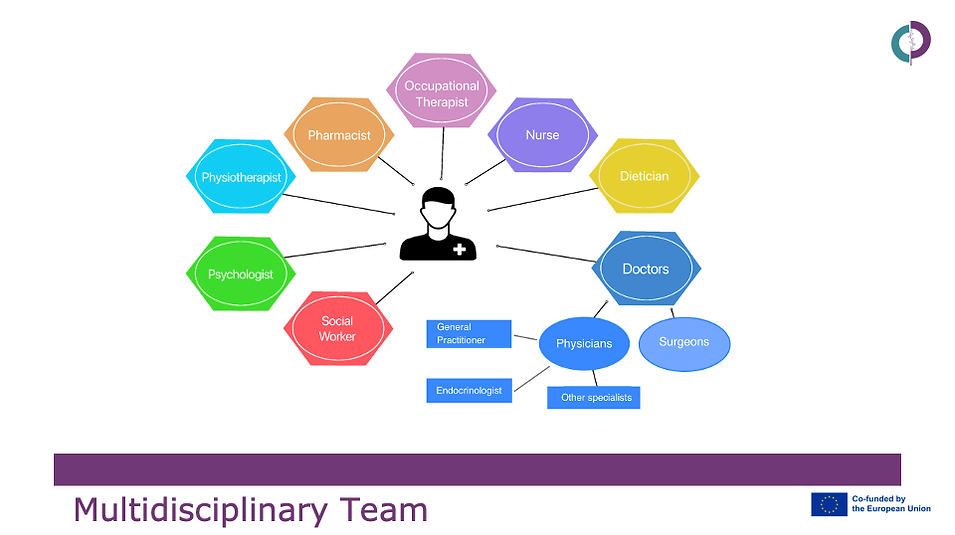
Physiotherapists have a key role to play in the multidisciplinary care of people living with obesity, working alongside doctors, dietitians, nurses, psychologists, pharmacists, occupational therapists, social workers, and most importantly - the patients themselves, to achieve lasting positive, holistic health outcomes. No matter what the severity of obesity or healthcare setting, physiotherapists have expertise and rehabilitation skills to offer the person living with obesity, including assessment, shared decision making, education and tailored treatment planning, support for behaviour change, physical activity
and tailored exercise prescription, management of comorbidities, ongoing evaluation and monitoring.
This resource was developed by the PROMINENCE team: Original
Awareness, Care, and Treatment In Obesity maNagement–International Observation (ACTION-IO) HCP
This infographic illustrates findings from the Action-IO study, publications which are available as open-access articles at the publishers’ websites:
The results suggest that persons with obesity (PwO) are motivated to lose weight and that there is an opportunity for HCPs to initiate earlier, effective weight loss conversations with minimal fear of offence. PwO may not recognise the need to reduce excess weight until it has an impact on their health, further supporting the need for HCPs to raise the topic of weight before such obesity-related complications occur.

Dicker et al. 2021. European Journal of Internal Medicine. doi.org/10.1016/j.ejim.2021.01.019
Under Creative Common License